Live casino · January 15, 2026
Baccarat basics for Philippine live-casino players
Player, banker, and tie bets explained with house-edge awareness.
 Live casino
Baccarat is one of the most watched games in Philippine live-casino lobbies: a clear table, a few main betting boxes, and a rhythm that feels easy to follow even if you have never shuffled a shoe yourself. This guide covers basics for adults 18 and older — Player, Banker, Tie, drawing rules at a high level, house-edge awareness, commission, side bets, pace, and session limits. It is educational, not a system for beating the game. Outcomes are random within the rules; the house keeps a mathematical edge on every main bet.
If you treat baccarat as paid entertainment with a clock and a budget, the basics below are enough to sit down without confusion. For habit tools around money and time, pair this with responsible play.
What you are betting on
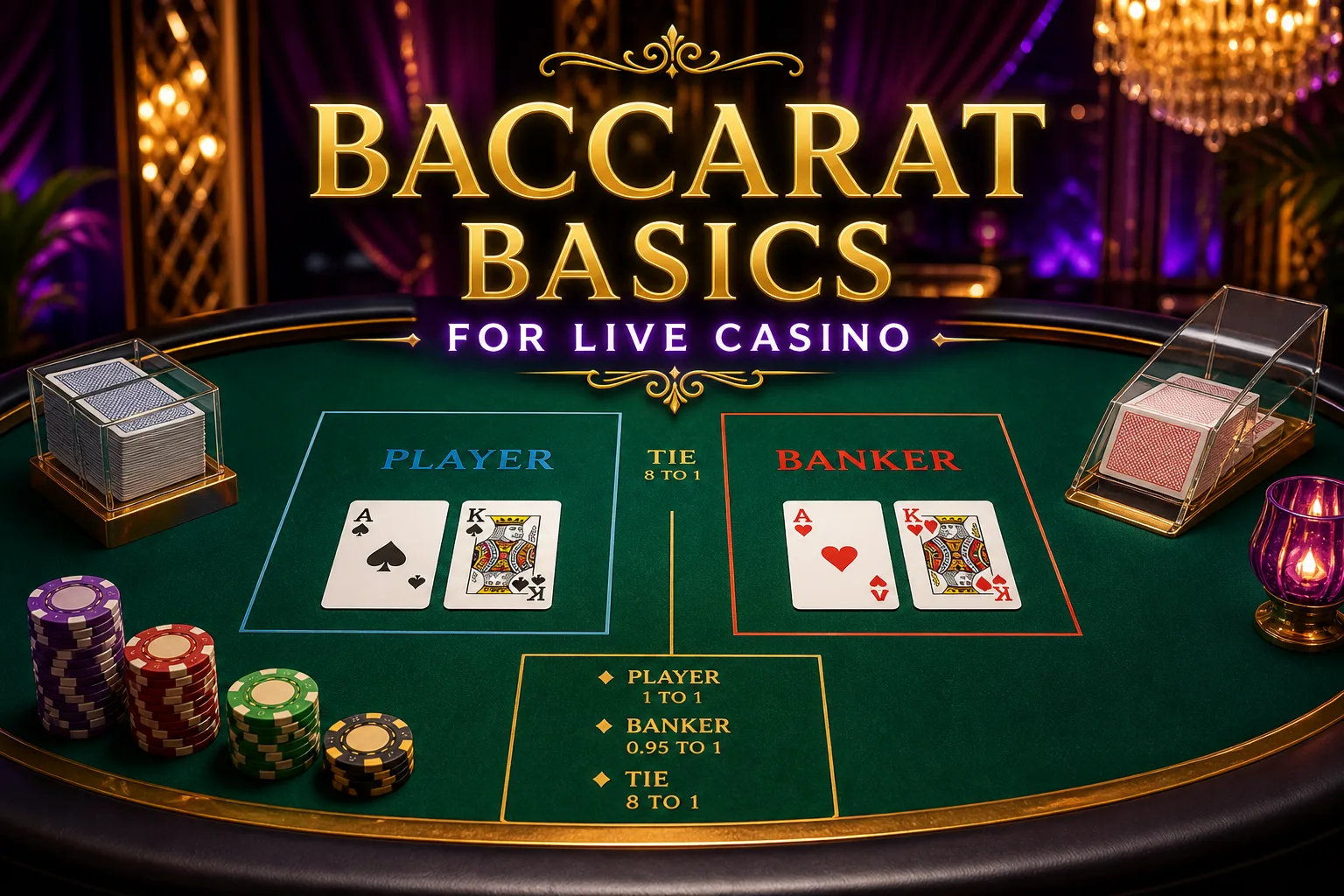
In standard punto banco–style baccarat used in most online live studios, you are not “playing a hand” against the dealer the way you do in blackjack. You wager on which side will finish closer to a total of nine — Player, Banker, or a Tie.
- Player bet: wins if the Player hand total beats Banker.
- Banker bet: wins if the Banker hand total beats Player.
- Tie bet: wins if both hands finish with the same total.
Cards are dealt to both sides according to fixed rules. You do not choose hits. That simplicity is why the game feels fast and why pattern boards can be misleading — there is little decision skill after you place the chip.
Card values and totals (quick orientation)
Baccarat totals use only the last digit of the sum:
- Aces count as 1.
- 2–9 count at face value.
- 10s and face cards count as 0.
Example: 7 + 8 = 15 → total 5. The goal is a total nearer to 9, not 21.
Two cards are dealt to Player and two to Banker. A third card may be drawn for one or both sides based on a fixed tableau. You do not need to memorize every line of the tableau to play recreationally, but you should know that draws are automatic — dealers and RNG engines follow the same rulebook regardless of what the roadmap “looks like.”
Drawing rules at a high level
Without listing every cell of the tableau:
- Naturals (totals of 8 or 9 on the first two cards) usually end the round with no third card.
- Otherwise, Player draws or stands according to Player’s total.
- Banker’s third-card decision depends on Banker’s total and, when relevant, the third card Player received.
Live dealers announce results; on-screen graphics show totals. If a stream hiccups, wait for the official settled result on the client rather than guessing from a partial camera angle.
House edge awareness: Banker, Player, Tie
Over the long run, not all boxes are equal.
- Banker typically carries a slightly lower house edge than Player in standard commission baccarat, which is why Banker is often considered the “least bad” main bet from a pure math perspective — not a winning strategy, just a smaller edge against you.
- Player is close behind but usually a bit worse for the player than Banker.
- Tie pays higher (commonly 8:1 in many layouts, sometimes different) and loses far more often. That combination produces a much higher house edge. Treat Tie as optional spice, not a default.
Exact edges vary slightly with rules (number of decks, whether Banker wins on ties are pushed, commission vs no-commission variants). The directional lesson stays stable: main-road Player/Banker bets are the recreational core; Tie is expensive entertainment.
Winning a few Ties in a night does not rewrite the edge. Short samples swing; the percentage works over many hands.
Commission on Banker wins
Many tables pay Banker at even money minus a 5% commission on winning Banker bets (so a ₱100 Banker win might net ₱95 after commission, depending on how the client displays it). Some “no commission” tables change Banker payouts on specific totals (for example, paying half on certain Banker wins) instead of charging continuous commission.
Before you sit:
- Check whether the table is commission or no-commission.
- Confirm how the client shows net payouts so a win amount matches your expectation.
- Include commission in mental bankroll math if you mostly bet Banker.
Misreading commission is a common source of “the payout looks short” confusion — often the table is working as published.
Side bets: entertainment with steeper edges
Live baccarat lobbies advertise pair bets, perfect pairs, big/small, dragon bonuses, and other side markets. They pay attractively when they hit and usually carry higher house edges than Player or Banker.
Practical approach for Philippine recreational players:
- If you use side bets at all, cap them as a small fraction of your hand budget.
- Do not “recover” a lost main bet by loading a side bet on the next round.
- Read the paytable once before first use; do not assume every studio uses identical odds.
Side bets are optional. Skipping them entirely is a valid basics strategy.
Table pace, limits, and session design
Live tables move on a timer: bet, deal, reveal, repeat. Minimum and maximum bets decide how long your bankroll lasts.
- A high minimum relative to your budget means few hands and more emotional weight per decision.
- Choose tables where your planned bet size allows dozens of hands inside your session loss limit — not three hands that force an early top-up.
- Notice speed: some VIP-style tables feel slower; others are brisk. Faster pace means you can hit time and loss limits sooner without noticing.
Set a hand count or minute limit before you join. Roadmaps and shoe history invite “one more” thinking. Past hands do not force the next hand. Streak boards are decoration for entertainment, not evidence of a due result.
If chat is available, keep it polite and never share payment details, OTPs, or wallet numbers in the chat panel. Dealers and hosts will not need those to run the game.
Live baccarat vs RNG baccarat
Live casino baccarat uses a real-time studio, physical cards (or studio-dealt shoes), and camera feeds. Latency, stream quality, and table open hours matter. Social presence and road displays are part of the product.
RNG baccarat resolves hands with a random number generator and digital animation. Rules for Player/Banker/Tie and third-card logic can mirror live punto banco, but there is no physical shoe theater. Pace can be faster; you can often finish more rounds per hour, which makes session limits even more important.
Neither format removes the house edge. Pick live for atmosphere or RNG for speed — then apply the same bankroll rules. Cross-check deposit and cash-out habits if you move between products; see deposit and withdrawal guides for payment hygiene, not for game strategy.
Session limits beat superstition
Baccarat culture is full of shoe stories, pattern names, and “Banker runs.” Enjoy the theater if you like, but anchor decisions to:
- Pre-set loss stop in pesos
- Pre-set time or hand stop
- Default bets on Player or Banker only
- Optional tiny side-bet allowance — or none
- Immediate exit when you start raising stakes to chase
Chasing a shoe is still chasing. The cards do not owe you a correction after a cold stretch.
Adults only: if anyone under 18 can access your device, lock it. Baccarat basics do not change the legal age line.
FAQ
Should I always bet Banker because of house edge?
Banker’s edge is usually slightly better than Player’s, but “always Banker” is not a profit plan — you still expect to lose slowly over a very long run. Many recreational players mix Player and Banker for variety within a fixed budget. Avoid making edge the excuse to raise stakes.
Why did Banker win but I received less than even money?
Commission tables deduct a fee on winning Banker bets, or no-commission tables may pay differently on certain totals. Check the table rules panel. This is usually rules, not an error.
Are roadmaps useful for predicting the next hand?
They summarize recent results. They do not change the independent dealing process of the next round under fair rules. Using them for entertainment is fine; using them as proof that a result is “due” leads to chase behavior.
Is Tie worth it when the payout is high?
High payout reflects lower hit frequency and a steep house edge in standard rules. Occasional Tie bets for fun are a personal entertainment choice; making Tie your main road is usually expensive. Cap or skip.
Closing
Baccarat basics for Philippine live-casino players reduce to a short list: understand Player, Banker, and Tie; accept automatic drawing rules; prefer main bets with clearer edges; respect commission displays; treat side bets as optional high-edge extras; pick limits that match your bankroll; and end sessions on time whether the shoe was kind or not. Play only as an adult 18+, for entertainment, with money you can afford to lose — and let the checklist, not the roadmap, decide when you stand up.