Fishing · October 9, 2025
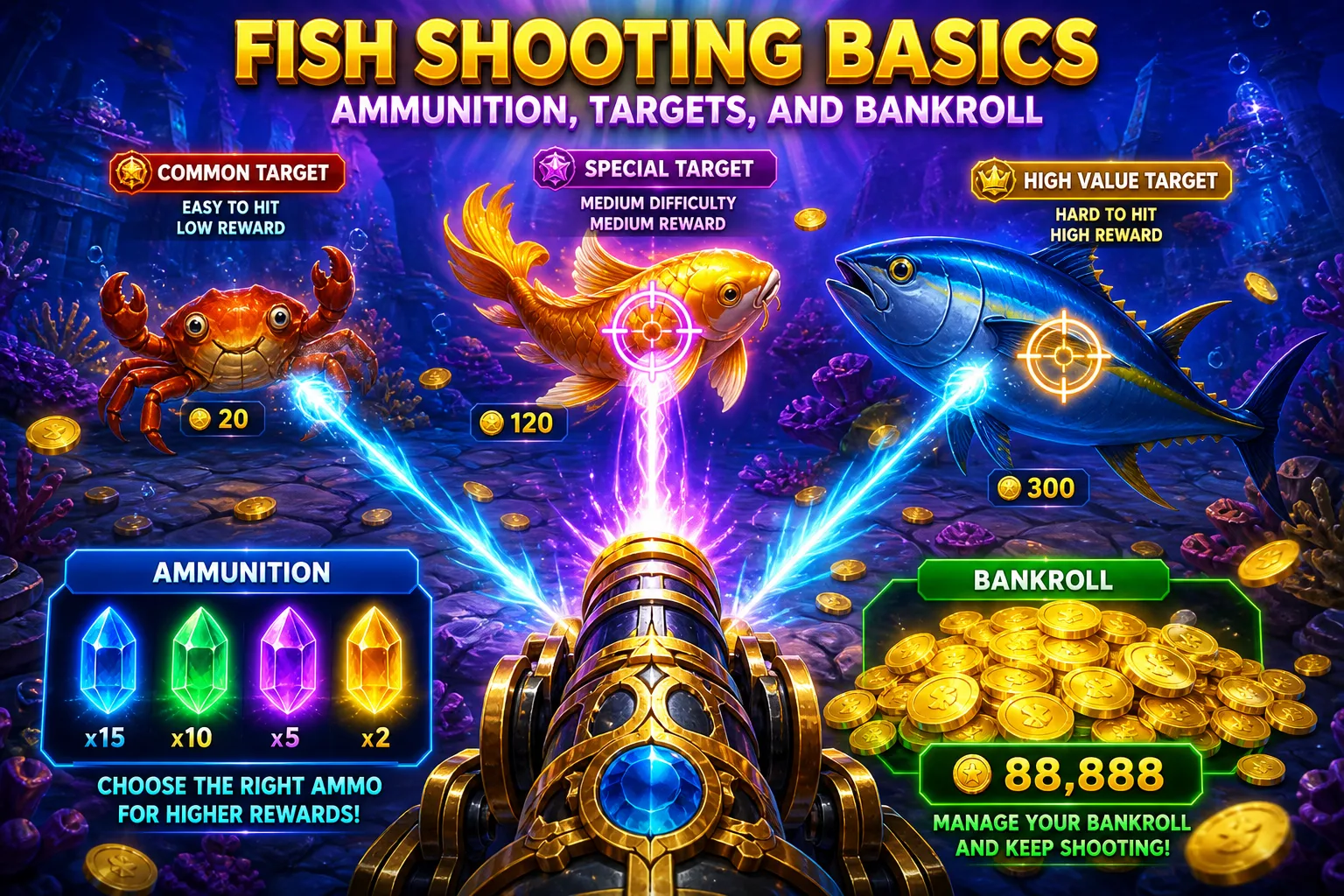
Fish shooting basics: ammunition, targets, and bankroll
How fish-hunter rooms work and how to avoid burning coins too fast.
 Fishing
Fish shooting (fish hunter) games look like arcade shooters: colorful sea life, cannons, and cascading coin pops. Under the animation, each shot is a wager. Ammunition costs money, targets return multiples when they “die,” and boss fish can swing a balance hard in either direction. Treating the room like a free mobile game is the fastest way to burn a bankroll.
This guide is for adults 18+ who want a practical map of fish-hunter rooms: how they work, how ammo equals bet size, how target value relates to difficulty, why bosses are high variance, what room multipliers do, how to think about burn rate, why jackpot chase is a trap, and how to set session stop rules. It stays on fish shooting — not slots, sports, or unrelated lobby fillers.
How fish-hunter rooms work
You join a room (sometimes shared with other players), choose a weapon or power level, and fire at fish that swim across the screen. When enough of your shots are credited to a target, that fish is captured and pays according to its value table — often shown as a multiplier of your shot cost.
Important framing:
- You are not farming a guaranteed harvest. Outcomes include chance. Hitting a fish visually does not always mean you are owed the kill on a fixed schedule; rooms use probability and payout models behind the art.
- Other players may share the scene. In multiplayer rooms, someone else can land the finishing credit. That is part of the format, not a personal insult.
- Special weapons, lasers, and freeze effects usually cost more per use or change shot economics. Read the room help before spamming them.
If you are new, start in a low-intensity room with cheap ammo and small fish until the controls feel natural. Skill here is mostly aim discipline and bankroll discipline — not a secret pattern that empties the ocean on command.
Browse fishing lobbies with the same caution you would bring to any real-money game: know the cost of every click.
Ammunition cost = your bet
Every bullet (or energy unit) subtracts from your balance at the selected power. Raising cannon power typically multiplies cost per shot. That can clear tougher targets faster when luck cooperates — and it can empty a wallet in minutes when it does not.
Think in burn rates, not in “just one more wave”:
- Cost per shot × shots per minute ≈ spend rate.
- If a room encourages rapid fire, your effective hourly cost skyrockets even at “small” unit sizes.
- Holding the fire button without a target priority is the arcade equivalent of max betting with your eyes closed.
Practical habit: pick the lowest power that still lets you contest the fish you actually want. Stepping up power “because the boss appeared” is a common tilt move. Decide power changes with a cool head, not mid-panic.
Target values vs difficulty
Fish usually follow a rough ladder:
- Small fish — lower multipliers, appear often, die faster. Good for learning aim and keeping feedback frequent.
- Medium fish — higher multiples, need more hits or higher power.
- Large / special fish — attractive multipliers, thicker health or tougher capture odds.
- Boss / event fish — headline prizes, long capture sequences, big swings.
Higher value almost always means harder or rarer capture, not a free upgrade. A 100× fish that eats fifty expensive shots can still lose money if capture fails or if another player finishes it. Value tables tell you the prize if you get credit — not how often that happens.
Study the room’s pay info. If a title hides numbers behind vague art, stay on tiny ammo until you understand what you are buying with each volley.
Boss fish and variance
Boss events are designed to feel cinematic: alarms, big sprites, screen effects. Variance follows the spectacle.
What to expect:
- Bosses can return large multiples — and can also absorb heavy ammo with no return for you.
- Shared rooms create competition for the kill credit.
- Some bosses have phases or weak points; missing those windows while spraying full power is expensive education.
A healthy approach: allocate a boss budget inside your session (for example, a fixed number of coins or a fixed minute window). When that slice is gone, return to smaller fish or leave. Never redefine your whole bankroll as “whatever it takes to finish this boss.” That is chase behavior wearing a costume.
Room multipliers and feature layers
Many fish games add room-level or event-level twists: coin multipliers, lucky times, chained bombs, or map themes that change fish mixes. These features can raise both entertainment and volatility.
Questions to ask before you lean in:
- Does the multiplier apply to capture awards, or only to certain fish?
- Does higher “room level” also raise minimum ammo or recommended power?
- Are jackpot meters or progressive-style prizes funded by play in a way that makes rare hits the marketing focus?
Multipliers do not erase ammo cost. A 2× room that tempts you to double fire rate can still double your burn. Treat features as rules to read, not as signals that the room is “due.”
Bankroll burn rate
Bankroll management in fish shooting is more urgent than in slow card games because input rate is high.
A simple planning sketch:
- Set a session coin ceiling you can afford to lose for fun.
- Estimate a comfortable shot cost so that ceiling lasts long enough to enjoy the room (for example, hundreds of intentional shots, not twenty panicked bursts).
- Track roughly how fast the balance moves in the first few minutes. If it is diving, drop power or leave — do not “win it back” with max cannon.
Wins are withdrawals from variance, not proof of a method. After a big capture, it is easy to feel invincible and raise power. That emotional spike is when many players give the room everything they just earned plus more.
For wider habit support, see responsible gambling. For other educational pages, skim the guides index — but keep this session about fishing mechanics.
Not chasing jackpots
Jackpots and ultra-rare fish are marketing magnets. Chasing them has a predictable pattern: small fish feel “too slow,” power goes up, balance bleeds, one near-miss on a boss reframes the loss as “almost,” and the next deposit feels justified.
Break the pattern early:
- Jackpots are rare by design.
- Near-misses are not coupons for the next attempt.
- The expected value of dumping a bankroll into one highlight fish is not improved by how badly you want the clip for your memory.
If the only reason you opened the room was a jackpot screenshot, reconsider whether fish shooting is the entertainment you want tonight — or whether you wanted a lottery dressed as an arcade.
Session stop rules
Write your rules before the first shot:
- Hard stop on coins spent (not “until I feel done”).
- Hard stop on time, especially on mobile where sessions blur.
- Optional win park: if you hit a pleasant plus, cash the feeling and exit.
- No revenge rounds after another player takes a boss.
When a stop hits, close the room. Returning later with a fresh ceiling is fine. Stretching “just five more minutes” after a stop is how ceilings become suggestions.
FAQ
Why did I hit a fish many times without killing it?
Fish hunter outcomes combine animation with probability and credit rules. Repeated hits do not guarantee an immediate capture, especially on high-value targets.
Should I always use maximum power?
No. Max power maximizes spend rate. Use the lowest effective power for your targets unless you have a deliberate, budgeted reason to step up.
Is it unfair when another player steals my kill?
In shared rooms, kill credit competition is part of the design. Frustration is understandable; raising ammo out of anger is still a bankroll mistake.
Can I grind small fish into a reliable profit?
Rooms are not built as reliable wage tools. Small fish can stretch entertainment time; they do not create a guaranteed edge over the house model.
Closing
Fish shooting is real-money arcade play: ammo is the bet, targets pay when credited, bosses amplify variance, and room features can raise both fun and burn. Learn the value ladder, keep power modest, refuse jackpot chase, and leave on a pre-set stop. That keeps the ocean entertaining — and keeps your bankroll from vanishing in a spray of optimistic bullets.