Live casino · December 6, 2025
Roulette basics: European vs American wheels
Inside and outside bets, house edge, and pace control for PH players.
 Live casino
Roulette looks simple: a spinning wheel, a bouncing ball, and a grid of numbers. Under that calm surface sits a clear math story. The biggest decision for most players is not which color to pick — it is which wheel type you are sitting at. European and American layouts look similar from a distance. They are not the same product.
This guide stays on roulette only. It covers European vs American house edge, inside and outside bets, even-money options, neighbors and specials in brief, why systems like Martingale do not beat the edge, and how to control pace at live casino tables. It is written for adults 18+ in the Philippines who want a calm, educational overview — not tips that promise wins.
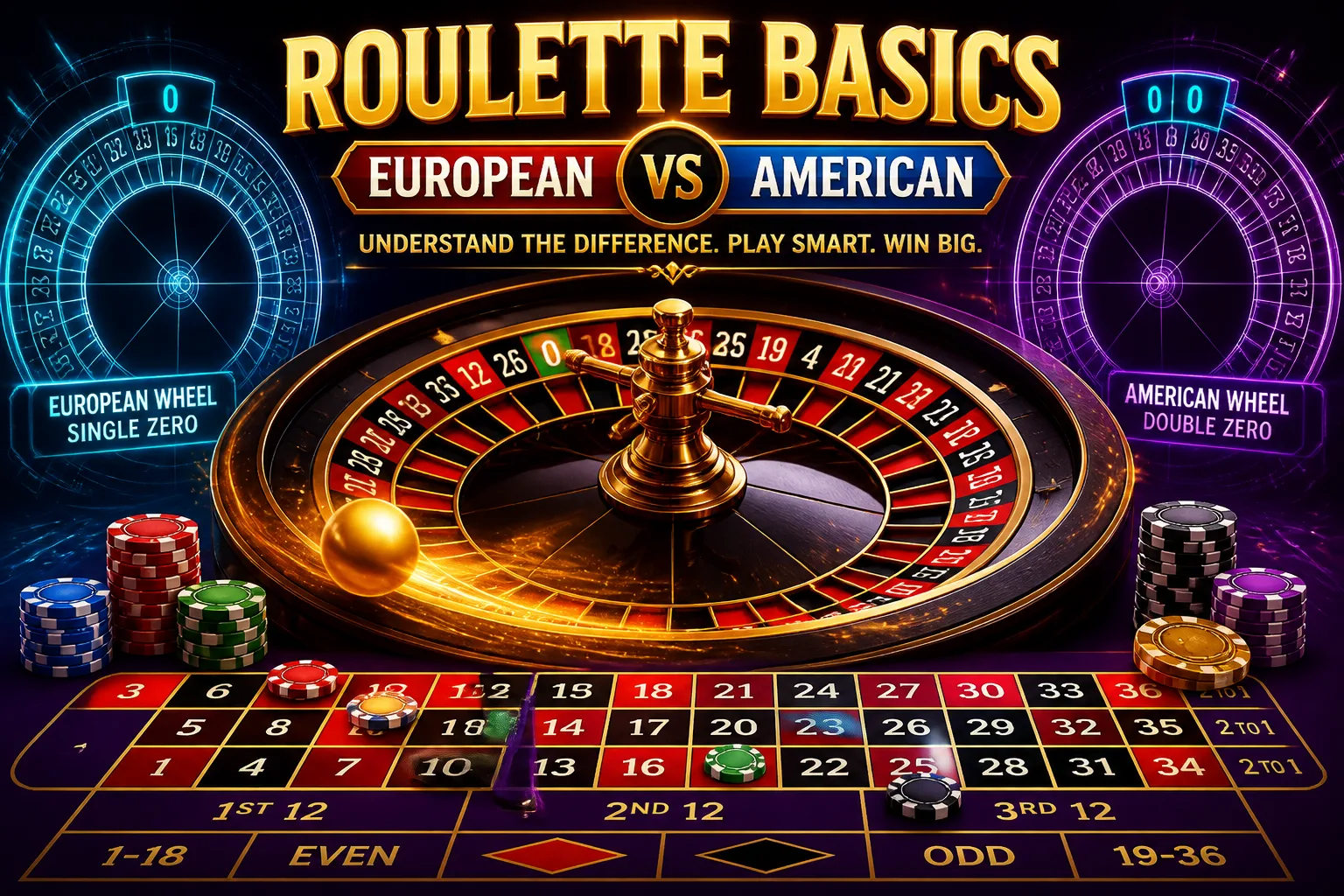
European vs American: why the zero matters
Every roulette wheel needs at least one green pocket so the house can earn a long-run edge. That pocket is the zero. How many zeros you face changes the odds on almost every standard bet.
European (and French-style single-zero) wheels use numbers 0–36: thirty-seven pockets total. One green zero.
American wheels use 0–36 plus a second green pocket, usually labeled 00. That is thirty-eight pockets.
The extra zero does not give you a new “lucky” number in a helpful way. It dilutes every other number. On a European wheel, a straight-up bet on a single number has 1 chance in 37 of hitting. On an American wheel, it is 1 in 38. Payouts for many bets stay the same (for example, 35 to 1 on a straight-up), so the house keeps more of the difference when there are two zeros.
House edge in plain numbers
For the common even-money bets (red/black, odd/even, high/low) on a standard European wheel, the long-run house edge is about 2.7%. On a standard American double-zero wheel, the same style of bet usually sits near 5.26%. That is nearly double the cost over time.
You will not feel that difference in one spin. You will feel it if you play often and treat every session as entertainment with a budget. Prefer single-zero tables when both options exist. If a lobby only offers American, know that you are buying a higher long-run cost for the same style of play.
Some French tables add “la partage” or “en prison” rules on even-money bets when zero hits. Those can soften the European edge further. Always read the table help text; do not assume every “European” label includes those extras.
Inside bets: higher payout, lower hit rate
Inside bets sit on the numbered grid itself — individual numbers and small clusters.
| Bet type (typical) | What you cover | Typical payout |
|---|---|---|
| Straight-up | One number | 35 to 1 |
| Split | Two adjacent numbers | 17 to 1 |
| Street | Three numbers in a row | 11 to 1 |
| Corner (square) | Four numbers meeting at a corner | 8 to 1 |
| Six-line | Two adjacent streets | 5 to 1 |
Exact naming and chip placement can vary slightly by studio, but the idea is stable: fewer numbers covered means a bigger advertised payout and a lower chance of winning on any given spin.
Inside bets are fine if you enjoy the drama of a long shot and you size them as a small slice of your session. They are a poor fit if you expect frequent hits to “pay for” the session. Frequency and payout trade off; the house edge still sits in the background.
Outside bets: more coverage, smaller wins
Outside bets sit around the grid: dozens, columns, and the even-money fields.
- Dozen (1–12, 13–24, or 25–36) and column bets typically pay 2 to 1 and cover twelve numbers each (excluding zeros).
- Even-money bets — red/black, odd/even, 1–18 / 19–36 — typically pay 1 to 1.
Even-money bets win more often than straight-ups because they cover about half the numbered pockets. They still lose when the ball lands on zero (or 00 on American). That is the edge working in slow motion: many small decisions, occasional green outcomes that wipe a “sure looking” half-table bet.
Outside bets do not remove risk. They change the shape of results — more frequent small wins and losses, fewer rare jackpots. For many recreational players, that shape feels calmer. It is still roulette, still random, still a cost of play over time.
Neighbors and specials (briefly)
Live and electronic roulette interfaces often show neighbors, tiers, voisins, orphelins, and other racetrack-style packages. These are convenience groupings of numbers based on wheel order or traditional French section bets. They can place several chips at once.
Treat them as bundles of inside-style exposure, not as secret edges. A neighbor bet still pays according to the underlying numbers that hit. The package does not change the math of the wheel. If the UI is confusing, skip specials until you are comfortable with plain inside and outside chips. Clarity beats clever layouts when you are learning.
Myths: Martingale and other progressions
The Martingale idea is simple: after a loss on an even-money bet, double the next stake so one win recovers prior losses plus a unit profit. Variants change the multiplier or reset rules, but the fantasy is the same — a system that “must” catch up.
Three problems show up quickly:
- Table limits stop doubling. A short losing streak can push you into a bet the table will not accept.
- Bankroll limits stop doubling even sooner. The sequence grows exponentially; a handful of losses can exhaust a session budget.
- The edge does not care. Each spin is independent. Past reds do not make black “due.” Doubling does not change the probability of the next result.
Progressions can create exciting charts and painful drawdowns. They do not convert a negative-expectation game into a positive one. If a method needs an unlimited bankroll and unlimited table limits to “work,” it is not a practical edge — it is a story.
Other myths deserve the same skepticism: hot and cold numbers as predictors, dealer signatures you can reliably exploit online, and apps that claim to forecast the next pocket. Treat marketing language about “systems” as entertainment, not science.
Pace control at live tables
RNG (software) roulette can fire as fast as you click. Live tables add a human dealer, camera, and a natural rhythm: spin, settle, next round. That rhythm is still fast enough to burn a budget if you bet every hand without a plan.
Practical pace habits:
- Decide a session ceiling and a time cap before the first chip.
- Prefer quality of attention over number of spins. Skipping a round costs nothing.
- Avoid stacking extra side or special bets “because the UI is open.”
- On mobile, notifications and multitasking make it easy to approve bets on autopilot — keep the screen focused or step away.
- If the lobby offers both European and American, check the label every time you sit; do not assume yesterday’s table type.
Live chat and other players’ banter can raise adrenaline. Use that energy for entertainment, not for chasing a loss with a bigger chip.
Putting a session together
A calm roulette session might look like this: choose a single-zero table when available; stick mostly to outside or simple inside bets you understand; ignore progressions; leave when the ceiling or timer hits. Wins feel good and losses feel sharp; neither outcome obligates another spin.
If you want broader table-game context afterward, browse other guides or review responsible gambling habits. For this article, the core takeaway is wheel type first, bet type second, systems never as a substitute for limits.
FAQ
Is European roulette always better than American?
For standard rules, single-zero European (or French) wheels usually offer a lower house edge than double-zero American wheels on comparable bets. Always confirm the exact rules on the table help screen, including any partage-style adjustments.
Do even-money bets have no house edge?
No. Even-money bets still lose when zero (or 00) hits. They hit more often than straight-ups, but the long-run edge remains with the house.
Are neighbor bets a smart shortcut?
They are a shortcut for chip placement, not a shortcut past the house edge. Use them only if you understand which numbers you are covering and what they cost.
Can Martingale work if I start with tiny bets?
Small starting units delay the problem; they do not remove table limits, bankroll limits, or the edge. A long enough losing streak still breaks the plan.
Closing
Roulette is a paced game of chance with transparent structure: zeros create the edge, inside bets buy drama, outside bets buy frequency, and no progression rewrites the wheel. Prefer European single-zero when you have a choice, learn the grid before you rush specials, and treat every session as paid entertainment with a stop point. That is enough skill for a clear-headed night at the table — and it keeps the focus where it belongs: on roulette itself.