Responsible play · April 16, 2026
Responsible play checklist for Philippine adults
Practical limits, warning signs, and help-seeking steps before you gamble online.
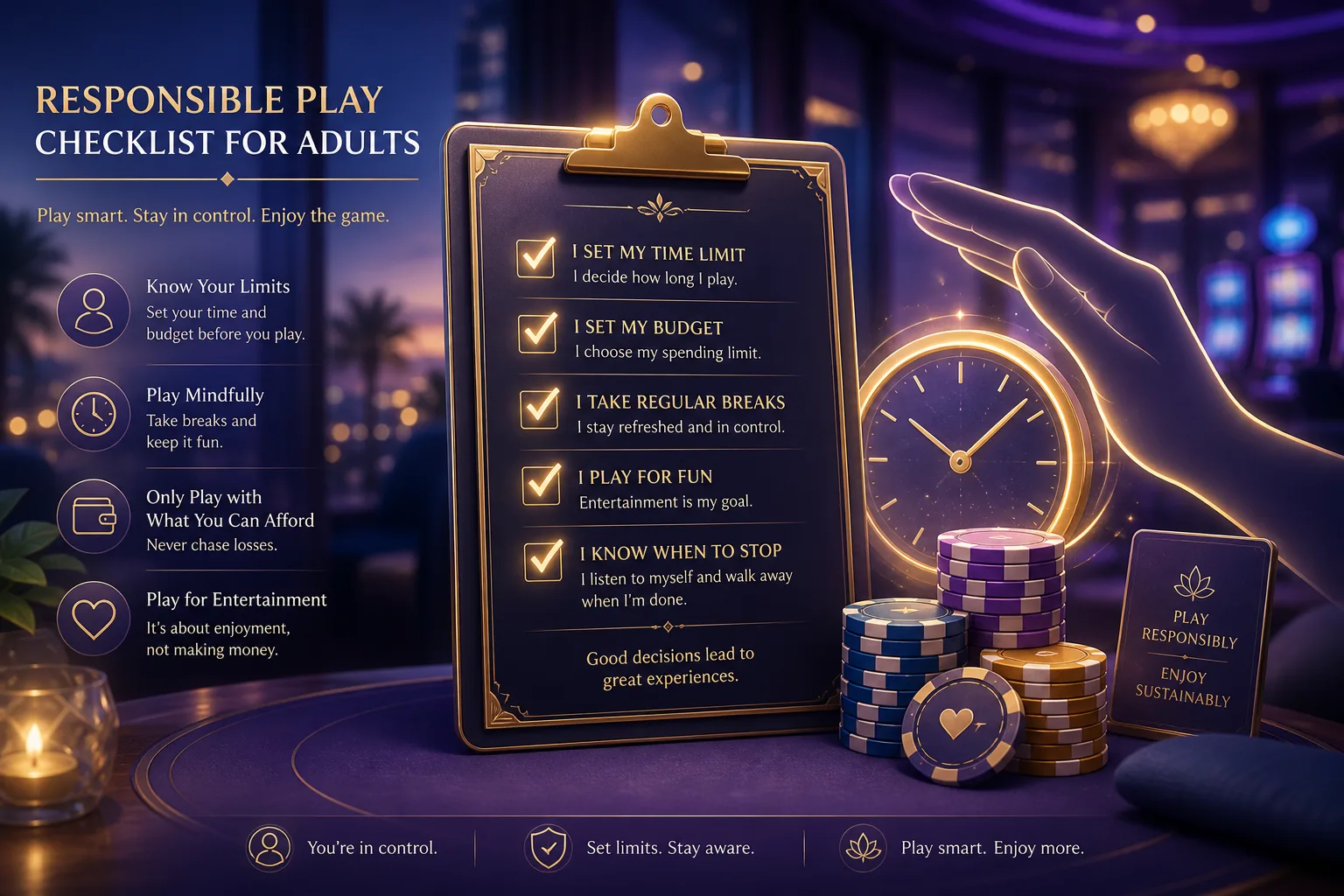 Responsible play
Online gambling is entertainment for Philippine adults 18 and older only when it stays inside a budget, a schedule, and a clear stop line. This checklist is for people who already choose to play and want to keep that choice from spilling into rent, tuition, or relationships. It is not a tutorial on how to win. The only outcome you can design in advance is how you treat money and time.
Use the sections below before you deposit, during a session, and after you log out. If anything here feels hard to follow, treat that as a signal to pause — not as a challenge to push through.
Before you play
Preparation is the part most people skip, and it is the part that prevents the largest share of harm. Do this on a calm day, not in the middle of a losing streak.
Money limits
Decide a monthly entertainment ceiling first, then a per-session deposit. Entertainment money is surplus after essentials: housing, food, transport, debt payments, and savings. If the surplus is zero this month, the responsible decision is not to play.
Write the numbers somewhere you will see them — a notes app, a sticky on your desk, or a shared household budget. Vague intentions like “I will be careful” do not survive a hot streak or a cold one.
- Monthly entertainment ceiling: a hard peso amount you will not exceed for all gambling combined.
- Per-session deposit: a smaller amount that fits inside that ceiling, even if you deposit more than once.
- Loss stop: the amount at which you end the session regardless of how “due” a win feels.
- Win stop (optional but useful): a profit level at which you cash out and leave, so a good session does not turn into a give-back.
Never fund play with borrowed money, payday advances, or money earmarked for someone else’s needs. If you need credit to continue, you have already passed the responsible line.
Time limits
Money is only half the risk. Long sessions blur judgment even when the wallet still has balance. Set a clock before you open the cashier: for example, 45 minutes, then a mandatory break. Alarms on your phone work better than “I’ll notice when I’m tired.”
Also decide when you will not play at all: late nights when you are sleep-deprived, days with family conflict, or hours when you are drinking. Alcohol and emotional stress both weaken the checklist you wrote when you were sober.
Account hygiene
Use only accounts in your own legal name. Keep login devices personal. Review deposit and withdrawal habits the same way you review any recurring expense — not as a game mechanic, but as cash leaving your household.
If you share finances with a partner, consider a brief agreement about entertainment budgets. Secrecy is one of the earliest warning signs listed later in this guide.
During play
Once the session starts, your job is to follow the plan you already made — not to invent a new plan mid-shoe or mid-spin.
Stick to the pre-set limits
Deposit only the amount you allocated. If the balance runs out, the session ends. Topping up “just once” is how monthly ceilings disappear in an afternoon. The same rule applies to time: when the alarm rings, log out even if you feel close to breaking even.
Treat every bet as entertainment spending, not as an investment recovering earlier losses. The house edge does not owe you a refund.
Avoid chasing losses
Chasing means raising stakes, extending time, or switching games because you are behind and want the ledger to look better before you stop. It feels rational in the moment and is one of the most common paths from recreational play to harm.
A practical counter-rule: after any losing stretch that hits your pre-set loss stop, you leave. There is no “one more round” clause. If you catch yourself negotiating with that rule, close the app and walk away physically — kitchen, balcony, short walk — before you decide anything else.
Pace and environment
Play where you can see a clock. Locked rooms and headphones make it easy to lose hours. Do not multitask gambling with caregiving or critical work — divided attention hides how much you have spent.
After you play
Closing the tab is not the end. A short review keeps patterns visible:
- Did I stay inside money and time limits?
- Did I deposit more than planned?
- Did I hide the session from family?
- Do I feel compelled to return immediately?
Log answers for a week. If you repeatedly break limits, shrink next month’s ceiling or take a full break. Move winnings you intend to keep into a bank or e-wallet you do not use for gambling so profit is harder to recycle impulsively.
Warning signs that deserve a hard stop
Responsible play includes recognizing when entertainment has become a problem. You do not need a formal diagnosis to take a break. Stop immediately and seek support if several of these apply:
- You think about gambling most of the day or feel restless when you cannot play.
- You hide deposits, receipts, or browser history from family.
- You borrow, sell belongings, or delay bills to fund play.
- You increase stakes specifically to recover losses.
- Arguments about money or time spent online are becoming frequent.
- You feel unable to stop even after promising yourself you would.
- Work, studies, or sleep are suffering because of sessions.
- You use gambling to escape anxiety, depression, or conflict rather than for light entertainment.
One warning sign can be a wake-up call. A cluster of them means the checklist alone is not enough — you need external help and a longer pause.
Help-seeking and PAGCOR exclusion tools
Asking for help is adult behavior. Start with someone you trust: a partner, sibling, friend, or counselor. Be specific about amounts and time if you can; vague admissions are easier to minimize later.
In the Philippines, the regulator maintains responsible gaming information and exclusion pathways. PAGCOR’s responsible gaming page outlines player and family options for self-exclusion and related controls used in regulated environments: pagcor.ph regulatory responsible gaming. Read the official wording carefully — processes, venues covered, and duration rules are defined by PAGCOR, not by informal advice.
Self-exclusion is a formal request to be blocked from participating for a set period. Family exclusion concepts exist so relatives can raise concerns through official channels when someone’s play is harming the household. These tools are not a punishment; they are circuit breakers when willpower is not enough.
Also use any deposit limits, cooling-off periods, and reality checks offered inside a licensed platform’s account settings. Enable them on a good day, before you need them. For a broader overview of safer habits on this site, see responsible gambling.
If you are in crisis — suicidal thoughts, severe debt panic, or threats to safety — contact local emergency services or a mental-health crisis line first. Gambling harm and mental health often travel together; treat the urgent risk first.
Entertainment framing that actually helps
Keep a sentence you can repeat: “This is paid entertainment with an uncertain outcome.” That framing blocks two traps: treating play as income, and treating a loss as a failure that must be reversed tonight.
Compare gambling to other leisure. If you would not spend the same amount on a concert without guilt, do not spend it on a session. A night that ends on time with money left is a successful entertainment session — win or lose.
FAQ
Is responsible play only for people who already have a problem?
No. Checklists are most effective before harm accumulates. Setting limits when you are calm is easier than inventing them after a bad week. Think of it like seatbelts: you wear them because driving has risk, not because you expect a crash every trip.
What if my partner wants me to stop completely?
Take that seriously. Household trust is worth more than any session. Negotiate a written pause, use exclusion tools if needed, and consider couples or financial counseling. Continuing in secret after a clear request usually worsens the relationship faster than the gambling itself.
Can I raise my limits if I am winning?
Winning does not change the house edge or your monthly surplus. If you want a higher ceiling, decide it between sessions and only from true surplus — never mid-session because the balance looks good. Many people who expand limits after a win give back more than they gained.
Where do I start if I already broke my limits this month?
Stop new deposits immediately. Tally what you spent. Tell one trusted person. Enable platform limits or start a cooling-off period today. Review PAGCOR’s responsible gaming information for exclusion options if you need a stronger block. Rebuild next month’s budget from essentials outward; do not try to “win it back.”
Closing
Responsible play for Philippine adults is a short list of non-negotiables: entertainment money only, written time and loss stops, no chasing, honest after-session review, and early help when warning signs appear. Use official resources such as PAGCOR’s responsible gaming page when you need formal exclusion. If you cannot follow your own checklist, the kindest next step is to stop and get support — not to find a new system that lets you keep going.